
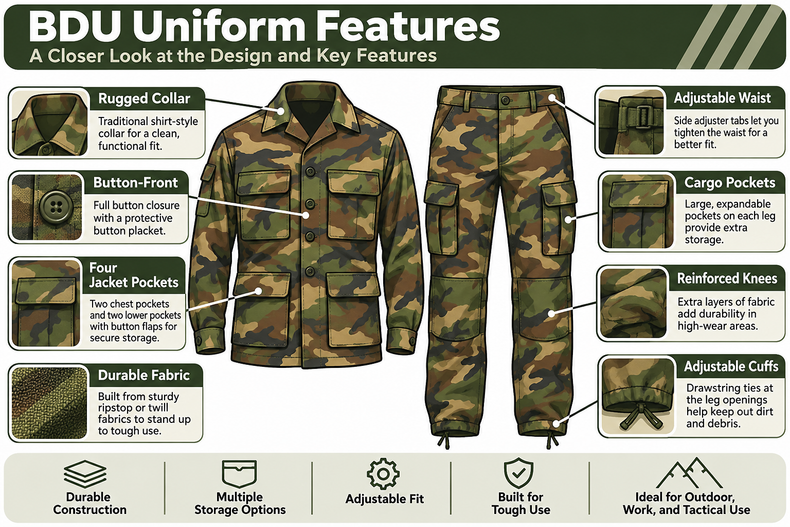
The military uses a lot of abbreviations that can be confusing. What does BDU stand for? BDU stands for Battle Dress Uniform, a type of military clothing introduced by the U.S. Armed Forces in the early 1980s. The clothing was originally designed for military field operations. Traditional BDU consisted of a camouflage jacket, matching pants, and headwear. Its practical design, durable construction, and distinctive appearance eventually made it popular for many people outside of the military.
Although the United States military has largely moved on to newer combat uniforms, BDU-style clothing is still widely available. You'll find all kinds of BDU style clothing worn by airsofters, outdoor workers, hunters, military fans, and people who simply appreciate a comfortable pair of cargo pants.
But what exactly makes something a BDU? And how is it different from modern tactical clothing or ordinary military-style pants?
Knowing where BDUs came from and how they are made can help you when making your choice on which clothing you need.
What Does BDU Stand For?
BDU is an abbreviation for Battle Dress Uniform, the name given to a standardized military field uniform adopted by the U.S. Army in 1981.
The uniform was designed to give soldiers practical clothing for training and combat situations. It replaced older uniform styles such as the olive-green OG-107 utility uniform as the military moved toward standardized camouflage clothing.
A traditional BDU was more than a pair of camouflage pants. It was a complete uniform system, with the jacket and trousers designed to be worn together.
The meaning for BDU has a broader meaning today.
Manufacturers will use "BDU" to describe clothing built on the traditional military design, even when the clothing is made for non military use. , For example, a pair of black BDU pants may share the same pocket arrangement and general construction as military camouflage pants without being part of an officially issued uniform.
What Is Included in a BDU Uniform?
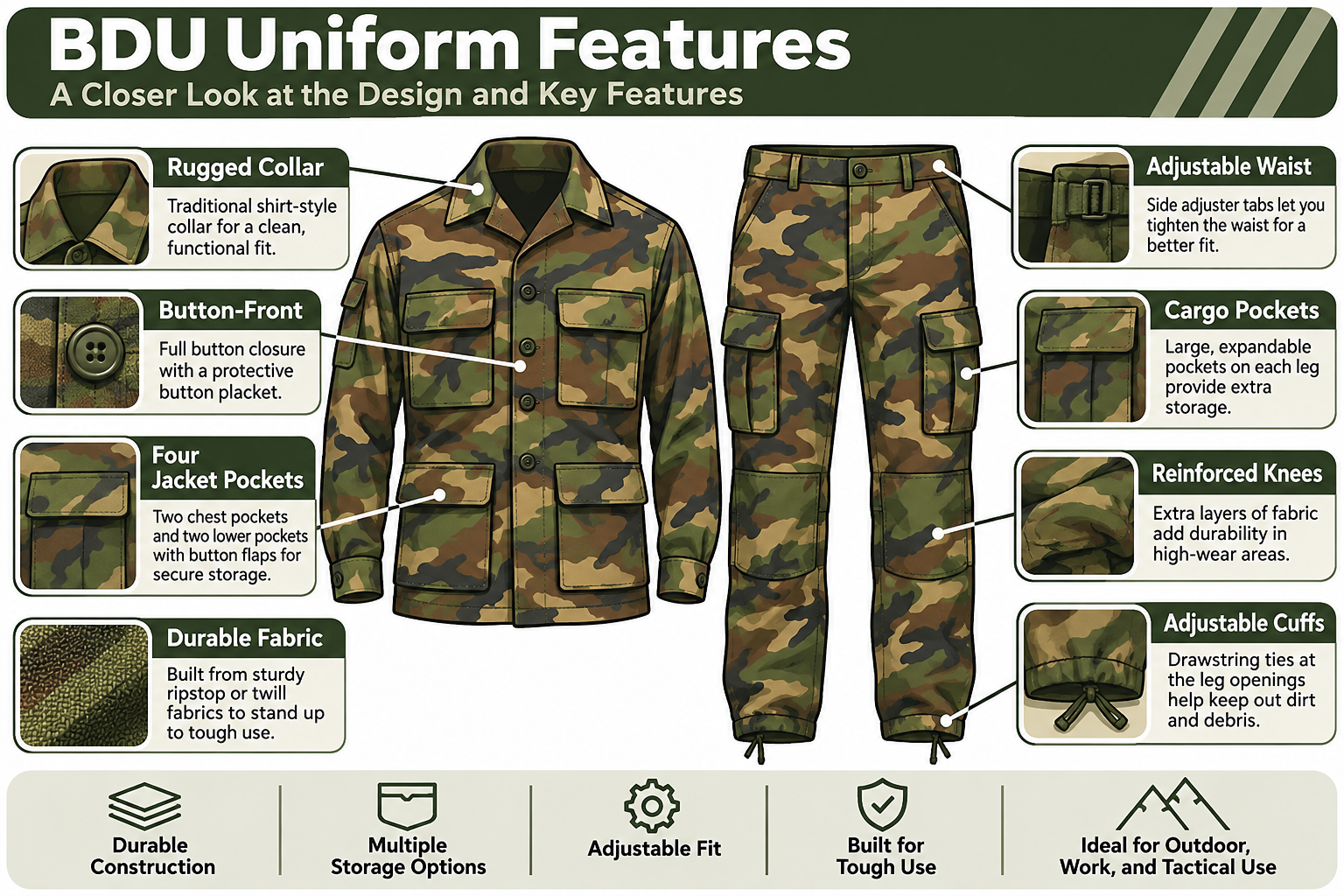
A traditional BDU is made of three primary pieces:
- BDU jacket or coat: A jacket or coat with a button up front with four exterior pockets, long sleeves, and a relatively loose fit.
- BDU Pants: Cargo-style pants with six primary pockets, reinforced areas, and adjustable features.
- Headwear: Usually a patrol cap or boonie hat, depending on the uniform requirements and activity.
BDU clothing was usually matched with boots, belts, appropriate badging, and other authorized equipment.
The uniforms were designed for practicality. Soldiers needed clothing that allowed movement, carried small items, and withstood the repeated use in harsh environments.
It is for a lot of these reasons that BDU remains popular with people outside of the military.
The History of the Battle Dress Uniform
The Battle Dress Uniform came out during a time when the U.S. military was reconsidering how soldiers dressed and operated in the field.
Before the BDU, American service members commonly wore solid-colored uniforms. Camouflage clothing existed, mainly for specialized environments and divisions, but the BDU helped establish camouflage as standard clothing across much of the military.
The woodland camouflage BDU introduced in 1981 featured a four-color pattern made up of green, brown, black, and tan. The pattern was intended for use in environments with woodland and vegetation.
The uniform's loose-fitting jacket and trousers provided a practical arrangement of pockets and reinforced fabric in areas that would usually wear down faster.
Over time, different camouflage patterns were introduced for specific environments such as operations in the desert. Desert operations created a need for clothing better suited to dry, open terrain.
The BDU became one of the most recognizable American military uniforms of the late twentieth century. You could find BDUs in training exercises, overseas deployments, and military pictures.
Why Did the Military Replace BDUs?
Military equipment is always changing as new tech comes out and uniforms are no exception.
As operational requirements changed, the military started developing uniforms that were designed to handle modern equipment and changing field conditions.
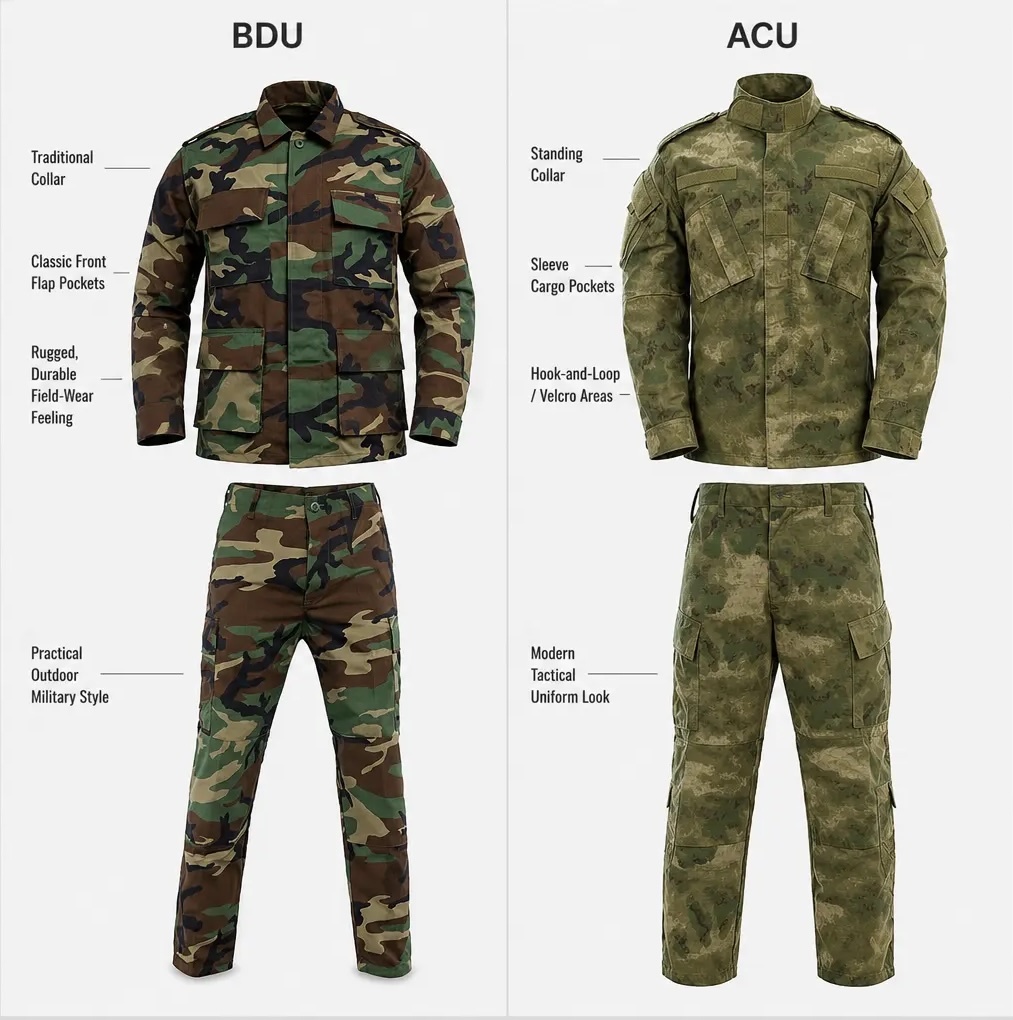
The U.S. Army introduced the Army Combat Uniform, or ACU, in 2004 and began distributing it to the field in 2005. Its design included changes with the location of the pockets, different pocket closures, and features made to work more effectively with modern combat equipment.
Camouflage development also played a major role in the switch to ACU.
Different military branches made their own changes to different uniforms on separate timelines so there wasn't one universal date when every BDU disappeared from the military.
Even though newer uniforms replaced traditional BDUs for most of the military, the original design continued to influence tactical and outdoor clothing for everyone.
What Makes BDU Clothing Different?
A BDU might look like ordinary cargo clothing with a camouflage pattern but the differences become more clear when you take a look at the construction of the clothing.
Traditional BDUs were designed around practical demands of military fieldwork. The relatively loose fit gave military personnel better movement and layering. The reinforced areas and strategically placed pockets improved issues with wearing BDUs long term.
Modern Commercial BDU clothing varies considerably but many manufacturers continue to use the original BDU design as a starting point for their clothing
The Six Pocket Design of BDU Pants
BDU pants had a standard six pockets which made them extra recognizable.
The standard configuration is made up of two front pockets, two rear pockets, and two large cargo pockets on the thighs.
Those cargo pockets are useful when carrying items that need to remain accessible without a backpack or separate equipment pouch.
Traditional military-style BDU pants also commonly include reinforced knees and seat for extra durability, adjustable waist tabs for minor fit adjustments, pocket button closures, drawstrings or ties at the ankles, and a relaxed cut that allows movement and layering.
These features aren't required on every BDU product. Some manufacturers keep their designs similar to the traditional design while others use stretch materials, different closures, or different fits.
Someone doing outdoor maintenance work may appreciate the cargo pockets for carrying gloves or small tools whereas an airsoft player might prefer the relaxed fit and adjustable ankles when wearing boots.
Neither use necessarily requires a camouflage pattern.
Black, olive drab, khaki, and other solid-colored BDU-style trousers are also available.
BDU Jackets and Shirts
Normal BDU jackets have a four-pocket layout with two chest pockets and two lower pockets on the front. They also typically use a button up closure on the front, have long sleeves, and a relatively straight, loose-fitting cut.
The simplicity of BDUs can be useful. A BDU jacket provides a practical outer layer for mild weather and outdoor activities.
BDU Fabrics: Ripstop, Twill, Cotton, and Blends
A BDU can feel completely different depending on the type of fabric used in the making of it. Traditional and modern BDU garments are available in different materials, including cotton, polyester-cotton blends, and nylon-cotton blends.
There are a few different types of fabric constructions that are used when making BDUs. Ripstop and twill are two styles that are commonly used.
Ripstop fabric is woven with a grid of thicker reinforcing threads that are geared to prevent small tears from spreading. Ripstop is often lightweight and commonly used in military and outdoor clothing.
Twill fabric is made with a diagonal weave that typically gives it a softer feel. It's commonly used in durable workwear and traditional BDU uniforms.
The main difference between the two is that Ripstop is designed to resist tearing, while twill is known for its durable construction, flexibility, and comfort.
Who Wears BDUs Today?
Although traditional BDUs are no longer the standard combat uniform of the U.S. Army, BDU-style clothing is super popular among lots of people today.
Outdoor Work and Recreation
BDU pants are a very practical option for different types of outdoor work, especially when extra pockets and a relaxed fit are desirable. Plus, they are extremely comfortable.
Landscaping, property maintenance, camping, and general outdoor fun all benefit from BDU clothing. The large thigh pockets give you room for small personal items, and the reinforced areas help you keep your pants nice without having to be worried about them.
Airsoft and Tactical Training
BDU clothing is perfect for airsoft because of its military origins.
Not only do Airsofters love BDU to look the part but the camouflage patterns can help players blend into outdoor environments. Airsoft also requires a lot of gear to be carried through games that may not fit into your plate carrier or vest. Cargo pockets give you convenient storage for airsoft accessories during gameplay.
A woodland pattern might work well in heavily wooded terrain while solid colors or other camouflage patterns may fit desert or indoor scenes. Either way, BDUs will definitely be an amazing addition to your airsoft loadout.
Everyday Wear
Not everyone buying BDU pants is interested in military history, airsoft, or tactical activities.
For a lot of people, they're simply comfortable cargo pants. If you look out for them, you can see a lot of BDUs worn in everyday outfits
The traditional relaxed cut is great for casual wear, and the large pockets give people storage that many ordinary pants don't provide.
Solid-colored BDU trousers are sought after because they have the practical design without drawing attention with camouflage.
How to Choose BDU Clothing
Choosing BDU clothing starts with understanding how you plan to use it.
A pair of pants for camping trips doesn't necessarily need the same features as clothing worn that you would wear daily
Before buying, consider the following factors.
Choose a Fabric That Matches Your Activity
For warm-weather use , go for the lighter fabrics so you can make sure you’re not overheating. Pay attention to fabric weight, ventilation, and ability to dry.
For rougher outdoor activities such as hiking, rock climbing, dirtbiking and more, look at the fabric construction and reinforcement in areas that could be worn down faster..
Pay Attention to Fitting and Sizing
BDUs are generally cut to give you more room in the pant legs than a lot of tactical or casual pants.
This extra room allows movement and layering, but it can be different than your normal pair of cargo pants.
Sizing with BDUs is usually measured with a waist and inseam measurement instead of a single exact measurement. Make sure to measure correctly so that your pants fit the first time.
Waist adjustment tabs on a lot of BDUs can help fine-tune the fit, so the pants will give you some grace when sizing.
Buying the Right Camouflage Pattern
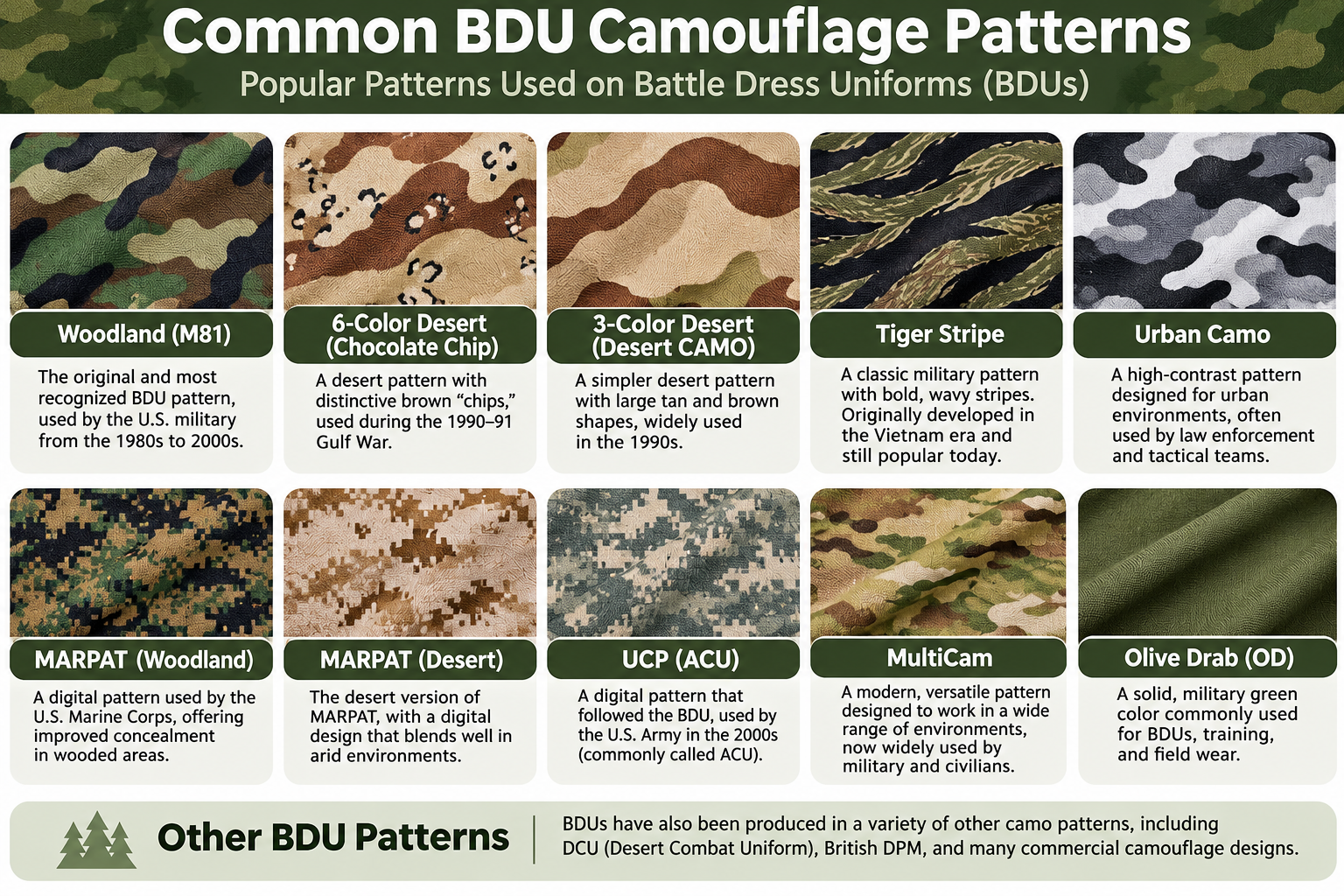
Camouflage is one of the most recognizable parts of military clothing, but different patterns are designed for different environments.
Woodland camouflage uses darker greens, browns, and black, while desert patterns use lighter colors intended for drier terrain.
Modern BDU clothing also comes in a wide variety of different patterns.
For outdoor activities, choose a pattern that fits your surroundings. For everyday use, appearance may be the factor you want to pick on.
Pay Attention to Construction and Pocket Design
When buying BDUs, look at pocket arrangements, closures, reinforced areas, stitching, and ankle adjustments. These details can make a huge difference in the preference of your clothing.
If you regularly carry small items, check whether the cargo pockets are large enough. If you spend a lot of time kneeling, reinforced knees may be worth prioritizing.
For activities that need frequent movement, make sure the cut allows you to do actions such as squatting, bending, and climbing comfortably.
Frequently Asked Questions About BDUs
Are BDUs Still Used by the U.S. Military?
The traditional woodland BDU is no longer the standard combat uniform of the U.S. Army. Other U.S. military branches also switched to newer uniforms on their own schedules.
BDU-style clothing may still appear in certain training organizations, cadet programs, and specialized settings. Uniform requirements vary by organization.
Are BDU Pants the Same as Cargo Pants?
BDU pants are a type of cargo pants, but not all cargo pants are BDUs.
Traditional BDU pants follow a military-inspired design that is usually made of six primary pockets, a relaxed fit, and features such as reinforced knees and adjustable waist tabs.
Ordinary cargo pants can have many different cuts, pocket arrangements, and materials.
Can Normal People Wear BDU Clothing?
Yes! In the United States, everyone can purchase and wear military-style BDU clothing.
Are All BDU Pants Camouflage?
No. Even though the original military BDUs were closely paired with camouflage, BDU-style pants are sold in solid colors as well.
Black, olive drab, khaki, and navy are examples of colors that can be found in military-style clothing.