
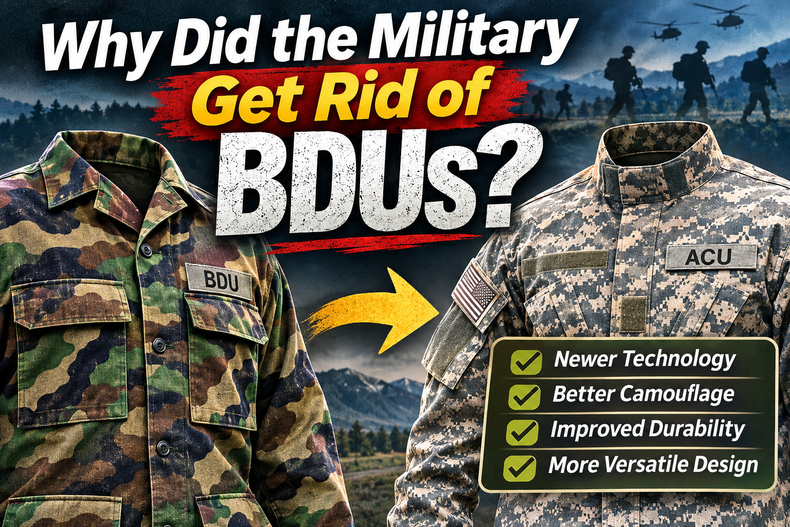
For more than two decades, the Battle Dress Uniform (BDU) was one of the easiest uniforms in the US military to spot. The woodland camouflage pattern, large cargo pockets, and comfy loose-fitting design became well known throughout the 1980s and 1990s.
But by the mid-2000s, the military was moving away from the uniform
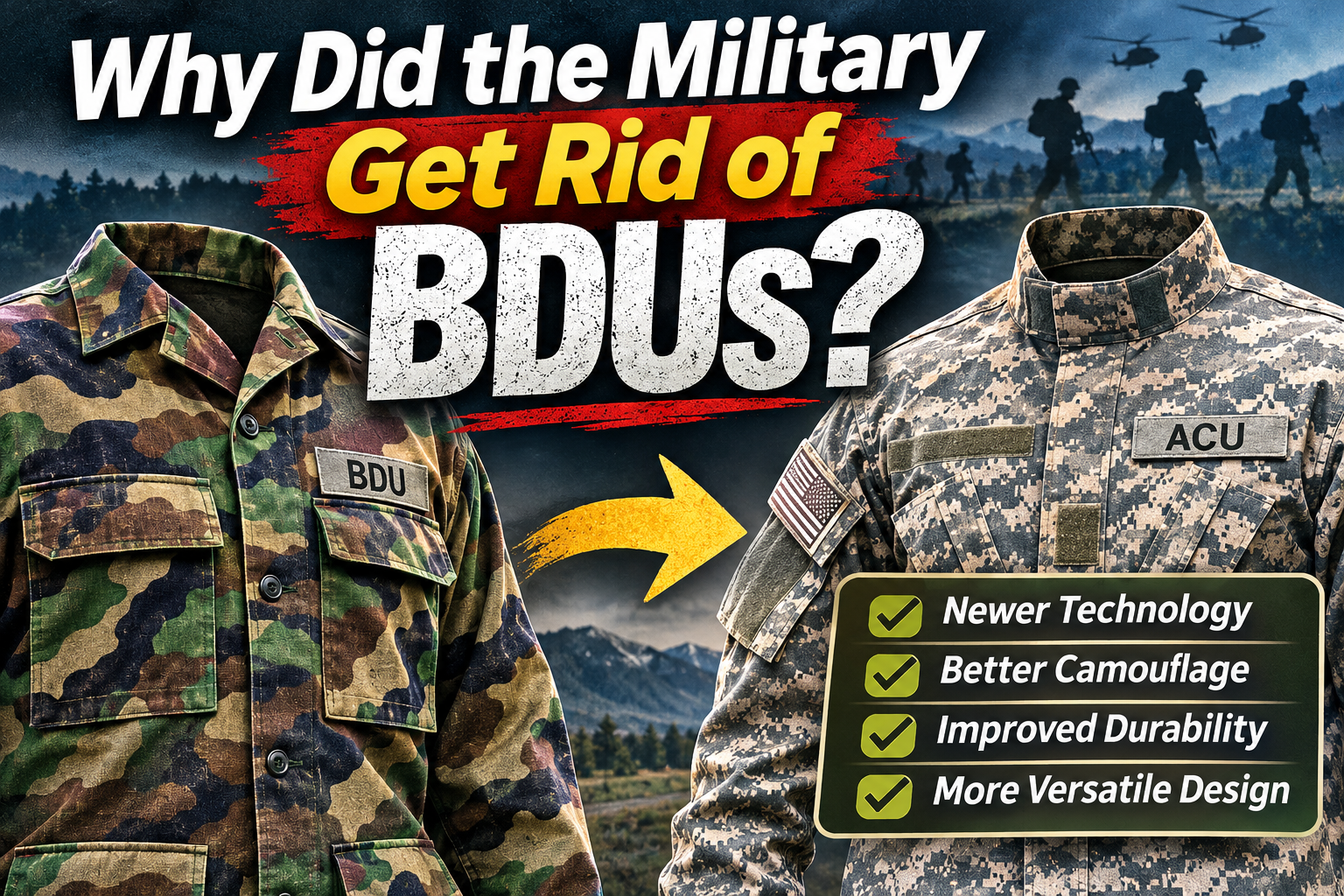
The military mainly replaced BDUs because newer uniforms had better compatibility with modern body armor, better access to equipment, and updated camouflage designs. The BDU wasn't a bad uniform. It was just designed for a different generation of military equipment and battlefield conditions.
The transition wasn't flawless though. Some changes were useful, while others, like the Army's original choice of camouflage, created new challenges.
The BDU Was Designed for a Different Time
The US Army first distributed the Battle Dress Uniform in 1981. It had a four-color woodland camouflage pattern, a button-front jacket with four pockets, and matching pants with six pockets.
The relaxed fit helped soldiers to move comfortably and wear extra layers underneath the pants. Reinforced fabric in high-wear areas allowed military personnel to worry about the task at hand instead of their clothes.
During the Cold War, the Army planned a lot of the designs on the potential military operations in Europe, where woodland camouflage was the best option. Other camouflage uniforms were developed for desert environments in other parrots if the world.
By the early 2000s, soldiers were carrying equipment that had changed drastically since the beginning of BDU's
Modern body armor, tactical vests, communication equipment, and other gear created new needs in the uniform design. Military operations in Iraq and Afghanistan also created the need for clothing designs made for different environments.
Five Reasons the Military Replaced BDUs
BDU Pockets Weren't Designed for Modern Body Armor
The traditional BDU jacket had four front pockets. Two on the chest and two near the waist. It was a practical arrangement when soldiers wore the uniform by itself, but it didn’t work quite as well once soldiers tried to wear body armor on top of the BDU.
With a protective vest covering much of the jacket, reaching those pockets could be hard. The lower pockets were especially annoying because they would often sit underneath the vest.
The Army addressed this problem when it developed the Army Combat Uniform (ACU). The new jacket had angled chest pockets and additional pockets on the upper sleeves, giving soldiers better access to small items while wearing their equipment.
It was a fairly straightforward improvement but it made a big difference to the soldiers who had to wear the uniforms.
Military Equipment Had Changed Considerably
When the BDU was introduced in 1981, soldiers weren't wearing the same protective equipment they would be using twenty years later.
By the early 2000s, body armor and load-bearing equipment became a lot more important in everyday wear to support new gear. The older uniform hadn't been designed with all of that equipment in mind.
The ACU had several changes that were made to make wearing that equipment more comfortable and practical.
One example was the mandarin-style collar that soldiers could wear upright to help protect their necks from rubbing against body armor. The traditional button-front jacket was also replaced with a zipper covered by a hook-and-loop flap.
These might seem like small details but consider how often a soldier bends, crouches, or reaches for equipment throughout the day. A collar that rubs against the neck or clothing that interferes with a protective vest can become a real nuisance after hours of wear.
The Military Needed Different Camouflage
The woodland BDU's green, brown, black, and tan camouflage was well suited to many heavily vegetated environments. It wasn't nearly as useful in a desert or an area dominated by pale rocks and sand.
The military already had separate desert uniforms, but keeping different camouflage patterns for different environments added complications.
When the Army introduced the ACU, it tried to address this with the Universal Camouflage Pattern (UCP). The pattern used a combination of gray, tan, and greenish-gray in a small, pixelated design. The idea was that they could have one camo pattern that could fit every environment
Unfortunately, it didn't work out.
UCP received much criticism for its poor concealment in certain environments, and the Army eventually replaced it with the Operational Camouflage Pattern (OCP).
Soldiers Wanted More Practical Features
The army took a lot of feedback from military personnel when designing the ACU. Soldiers had a big part in evaluating the new uniform and their feedback helped shape several design changes.
Some improvements were as simple as relocating pockets or changing how they closed.
The ACU also made better use of hook-and-loop fasteners, used for attaching name tapes, rank badging, and other identification patches.
There were advantages to both designs, and not everyone preferred the newer features.
Still, the Army was trying to address practical complaints about the older uniform instead of just giving soldiers a different-looking outfit.
5. Each Military Branch Was Developing Uniforms for Its Own Needs
By the early 2000s, the BDU had been around for more than twenty years. Military equipment had changed, and the different service branches were reconsidering what they needed from their field and working uniforms.
The Army wasn't alone in switching to a new design.
The Marine Corps introduced the Marine Corps Combat Utility Uniform (MCCUU), which used its MARPAT camouflage in woodland and desert versions. The Air Force later adopted the Airman Battle Uniform (ABU) and the Navy developed its Navy Working Uniform (NWU).
The replacement schedules varied. The Army stopped authorizing traditional BDUs in 2008, while the Air Force continued allowing them until 2011.
The switch from BDUs to ACUs is often talked about as one big military-wide change, but that's not quite how it happened. The ACU was the Army's new uniform, while the other branches introduced their own designs to better suit the work they did.
When Did the Military Stop Wearing BDUs?
The retirement of the BDU happened gradually as different branches introduced replacement uniforms.
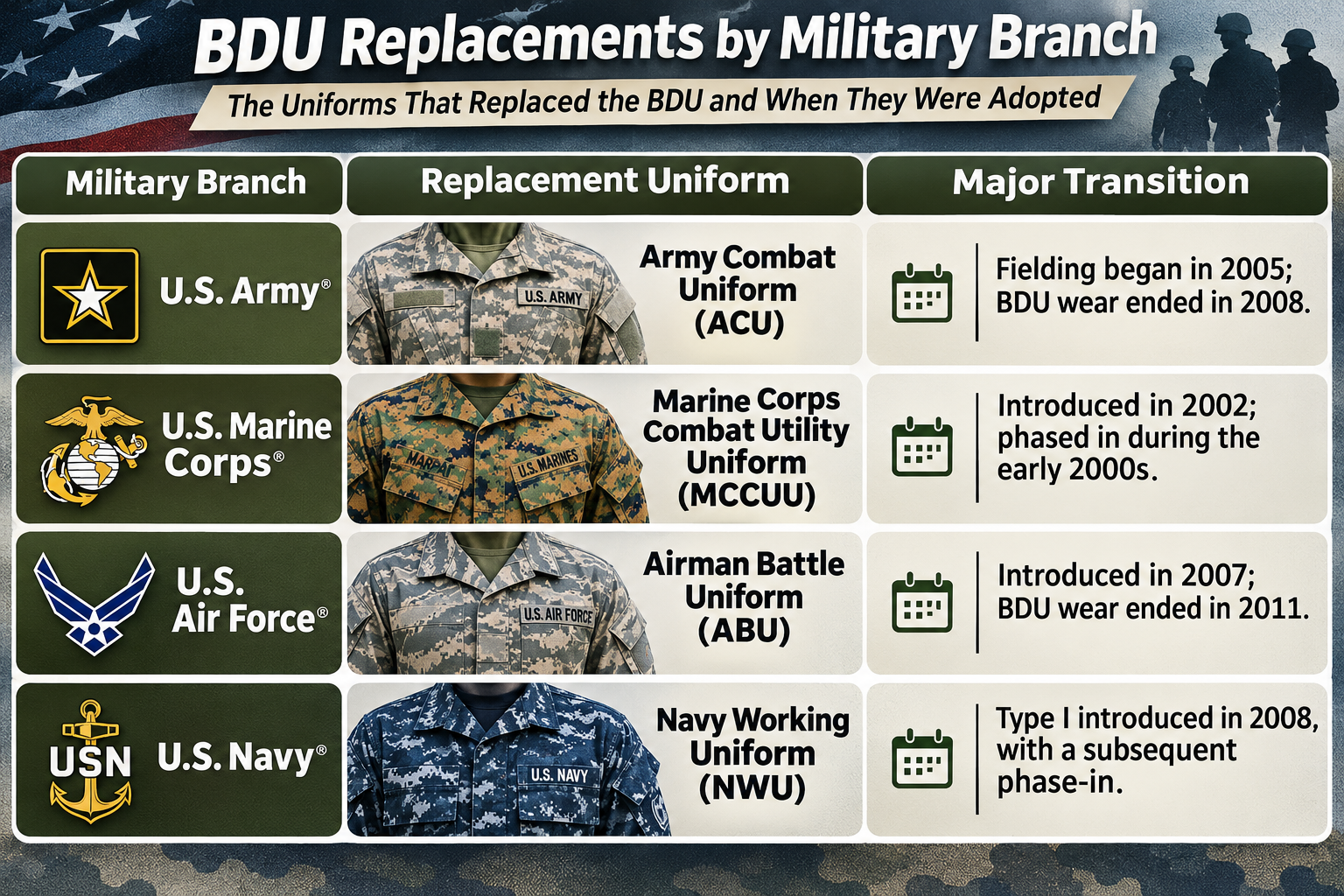
The Army's official BDU wear-out date was April 30, 2008, while the Air Force continued authorizing BDUs until November 1, 2011.
The Marine Corps began its transition earlier, introducing MARPAT camouflage with separate woodland and desert patterns.
The Navy followed a different path because sailors used several types of working uniforms depending on their assignments. Because of that, there isn't one retirement date that accurately describes every Navy uniform.
Was the ACU Actually Better Than the BDU?
In several respects, the ACU addressed legitimate limitations of the older uniform.
Its redesigned pockets were easier to access with body armor, and other construction changes were intended to improve compatibility with modern military equipment but the original ACU also demonstrated that newer doesn't automatically mean better.
The Universal Camouflage Pattern became the most obvious example. Despite being designed for multiple environments, the performance of it was questioned, eventually leading the Army to adopt a different pattern.
Some people also preferred aspects of the traditional BDU, such as its button closures and familiar construction.
In the end, the better uniform depends on its intended purpose.
For soldiers wearing modern body armor and carrying contemporary equipment, the ACU had features specifically designed for those requirements.
For someone who simply wants comfortable, durable cargo clothing, those changes may offer little practical advantage.
Why Are Traditional BDUs Still Popular Today?
Just because the military moved on from BDUs doesn't mean people stopped wearing them. Many of the features that made them useful to soldiers are just as practical for everyday use.
BDU pants have enough room to move around comfortably and the large cargo pockets are nice when you're working outdoors or carrying extra gear. Many traditional designs also have reinforced knees and seats which can help them hold up to wear.
That's why you'll still see BDUs worn by people working on their property, camping, hiking, skateboarding, playing airsoft, or just out and about. They are practical pants, and you don't have to be doing anything tactical to appreciate them.
Plenty of people wear BDU pants simply because they like the fit and style. The extra pockets are convenient, and the looser cut can be more comfortable than a lot of other cargo pants.
Manufacturers still produce BDU-style clothing in original camouflage patterns, along with solid colors like black, olive drab, and khaki.
Why the BDU Still Matters
The Battle Dress Uniform was a staple in the American military for decades, and the replacement of it reflected changes in how soldiers operated and what equipment they carried.
Modern combat uniforms brought soldiers features intended to work better with body armor, improve access to equipment, and get the right style for changing camouflage requirements.
Even though the military moved on, traditional BDUs are still an important part of clothing. They are still some of the best clothing you can find on the market today.